Thursday, March 01, 2012

AIRLINES IN THE NEWS - INDIA 2012 VERSION


The earlier blog was published in 2006 and available on this link HEREThis is an updated version of the same.

Airlines make news for all kinds of reasons and lately it is all for all the wrong reasons. Airlines Worldwide are having problems compounded by rising fuel prices. Airlines in India, however, face a multitude of problems starting from the promoters own fault of improper business plans and setting out in a business that has generally a very low tolerance for mistakes of any kind to a regulator who believes in reacting to situations than action to prevent something from happening and the problem carries on to poor planning, high cost of fuel, irrational pricing and as one can see, it starts becoming one long endless list of woes.

Now, coming to the story in India, people who made claims that their Airline will make profits from the first year of starting operations, face heavy losses, if one cares to remember flamboyant Liquor Baron Vijay Mallya’s statements when they first launched their Airline. It’s not good times for them or their competition, even though the Indian market has grown tremendously and is set to grow at a rapid pace further.

I don’t claim that I was the only one who saw it coming when I made those predictions in 2005/06 (and got a lot of flak for it back then), about losses in aviation and the need to merge, consolidate and all that, there were a few others, but industry captains at that time were quite smug in their attitude. Not too many of the so-called experts whose sound bites get recorded from time to time in India predicted a bloodbath in terms of red ink. I did, but got ink thrown at me for being overly negative in outlook. Now fast forward from 2005/06 to 2012 and I am clearly vindicated. I never wished something bad to happen, only saw that the learning curve that the Airlines in India were starting on was something we had all gone through and seen in the West. Now who listens to free advice?

One of these Aviation expert organizations even gave away awards for Airlines as being the best in terms of glitz, glamour, quality of service and so on. Of course surveys were conducted using passenger’s feedback and that too in the era before IndiGo came around and offered on time reliable service. Pamper a guy and he'll love you. Ask him about management of the Airline, ground operations chaos, technical deficiencies and he'll give you a blank look. No wonder die hard Kingfisher fans feel let down by their favourite Airline’s dismal performance. Pampering your customer is good but how about running a profitable company? How about getting an award for being the most profitable or even barely viable Airline of the year? First prize goes to so and so Airline for making ends meet. That would be good. I had said in that 2006 Blog that there would be no Airline in India that can claim this prize at the moment. That was before IndiGo started and now quietly going about their business for expanding their fleet and network across India and a few International sectors.

The Captains of the industry only saw roses or fooled the public into thinking that way and made money out of them. Case in point Jet Airways Initial Public Offering priced at Indian Rupees 1250 (was it) and the share value is now down to less than half the IPO amount. This is what I wrote back in 2006. JetAir stock price today in Feb 2012 is approximately Rs.306!  Even less than I had thought it would sink to from its lofty IPO offering that was lapped up by investors. I was one of the few holding a red flag and no one bothered.

Here is a paragraph I wrote in 206 that still holds good, mostly, even now: “Sure there are genuine problems of tarmac space; congestion in the skies, antiquated air traffic equipment and systems, ill-trained foreign (chaps who can't speak English well enough to be understood by ATC) and Indian pilots (who can't land in Delhi in fog because they are not suitably trained), add the lack of quality middle and upper management and the masala becomes a dangerous mix. Add to this broth, the offering of free seats, deeply discounted cheap tickets, free gifts, low cut blouses and short skirts and you’ve got the public salivating and traveling in larger numbers than ever before. Good for the common man and he should make the most of it while the party lasts”. Cut to 2012 and apparently the party is over for many players! Air Deccan is long gone and so is Air Sahara. The party animal, King of Good times Kingfisher, moves from the edge of the precipice being held back  by a single strand of hair.

I wrote this in 2006: That’s when mergers and consolidations become a necessity, and I still predict some large scale bankruptcies that will leave a lot of employees and others high and dry. People who you see on TV sporting large smiles and making outlandish predictions will get out of the business, surely they are packaging the business to sell- cut to 2012- I said this of Kingfisher Airlines who is now banking on foreign Airlines to come in an pump in fresh equity.

I said in 2005/06: “Airlines in India have already consolidated in one way. They have formed a lobby of sorts. Long term scenario? Let’s see now. I'l close my eyes, pretend I am a soothsayer and predict that a couple of Airlines are going to go down (as in closing down, don’t want to scare the reader), a couple of them being sold off and a few mergers happening. Result will be that the fare paying passenger is going to have to pay more money, that’s for sure. In any case, running an Airline below cost (or any other business for that matter) is not viable. Don't need to be an expert to say this”.

Also in 2006, I wrote: “There’s another curious activity going on these days that’s also making news. Financial companies, investment firms and other corporate types are buying up small equity shares in some of the Airlines. I don’t know why and some seem keen on picking up larger equity. I don’t know who is advising these guys and I’ll bet there is an army of CA’s and MBA’s in ties involved. Oh, I did hear some sound bites from the “experts” about this and they were saying: “these are very positive a signs indeed, signs of maturity, such an investment lends credibility etc etc” and all that hogwash these guys come up with. And they get paid a mint, mind you, to say all this rubbish”. Remember the late 90’s when over a hundred chaps in ties converged on Damania Airways and the Airline was taken over by NEPC Airlines in what was then termed as the “fastest Airline take over in the history of aviation”. Remember that? What the business magazines, newspapers and TV’s forgot to mention later was, that this was also perhaps the “fastest Airline to go down the tubes after the takeover in history”. Leave the suits and ties chaps who came out Biz schools out of this, they don’t understand aviation. You don’t wear a suit and sit in an office and learn about aviation”.

I come back to the present day and can’t help feeling despondent about what I wrote back then 5-6 years ago. I am not happy at being proven right. Anyway, moving forward, here are things that I see currently happening. Indian Government, after a long stupor has decided to favour some players and permit foreign Airlines FDI in Indian aviation. They have also decided to let go of their Oil companies monopoly to help Airlines import fuel directly and avoid paying taxes. Are these moves going to help? I am left wondering about it too. While these are factors that may help bottomlines, I still don’t see anything but an erosion of values in the Industry.

One can throw freebies and incentives one after another to help the sector but fundamental changes need to take places, starting immediately by professionalizing the DGCA into a Civil Aviation Authority. The Airlines have to go back to the drawing board and put a practical business plan together, one that will help them grow and consolidate steadily instead of a mad ego driven rush to topple so and so from the top of the leader board. Pragmatism must set in. A fundamental shift in the sector must take place. Innovation must be a driver in this endeavour. I see some of them doing this, like IndiGo. Rest of them, including state owned Air India is sleep walking as I see it. Unless they re-invent themselves, Airlines like Kingfisher and others will keep afloat only by kicking the can further down the road. And that is never a solution for an Industry with wafer thin margins. Let us hope that the aviation sector in India and elsewhere have Happy Landings in the future, in the near future. We can only hope. 

Thursday, January 26, 2012

Blue Whales of Sri Lanka

January started off well and a trip overseas to Sri Lanka happened. I've been to this beautiful island Nation many times in the past but now that the internal conflict is over and peace reigns, its a greater pleasure to visit and do business or go on a holiday. 

Before I start off on my Whale of a Tale, let me update some important information on travel to Sri Lanka. As of January 2012, all visitors to Sri Lanka need to apply and obtain an ETA (Electronic Travel Authorization) before embarking on their trip. The one-arrival visa has been scrapped for all Nationalities except Singapore and Maldives, both of whom have given visa free entry to Sri Lankans and hence the reciprocal benefits. An ETA is  Visa that you apply, pay and receive approval entirely online. It is a very simple process, just visit this website and follow easy instructions: http://www.eta.gov.lk/slvisa/ It took me 10 minutes to complete, cost me $10 for a double entry visit visa and authorization came by email very soon after. For a limited time, the SL Authorities will still allow foreigners to come without the Authorization, go to an ETA desk at the airport, fill up forms, get Authorization and then go for immigration clearance. This will cost you more and waste so much time and the service may not be available in a couple of months time, so its better to do it online like I did. 

(whale watching boat)

Mirissa is a fishing port about 40 kilometres due East from Galle in Southern Sri Lanka. No one visited the place during conflict years because there was nothing going on except fishing. With the onset of peace and information moving freely, it soon came to light that a few Kms into the sea off Dhondra Point was a pod of "resident"Blue Whales. The best whale watching season in this area is between December and March. All of a sudden, with the news of the whales spreading, the sleepy village of Mirissa became a hotbed of activity with new hotels coming up and new boat operators taking to the Whale watching business. The Sri Lankan Navy pioneered the whale watching trips and still operate on certain days. 

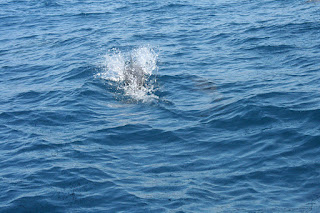
(Look for the fine mist when the whale exhale)

What are these Blue Whales, you may ask. To put it simply, they are the largest animal on the entire planet. There is nothing living on Earth that comes even close in size to these magnificent leviathans of the Deep. Nothing. More info on these beautiful mammals of the Deep is available on another blog mentioned below. Whale watching trips leave very early in the morning and hotel pick ups start around 0600Hrs. There are around a dozen or more boats of various sizes and configuration, that are privately owned and operated. The charges can range from LKR 5,000 to LKR 9,000 (1 US$ = 113 LKR) per person. Once everyone's settled in the boat and life jackets put on, the Coast Guard comes along and takes down the names, passport number and signature of the passengers and makes sure that no boat is carrying more than 25 people. While this is good practise, there is no order or method to the operation of these Whale boats and their methods of chasing down whales leaves much to be desired among us Cetacean lovers who know a thing or two about Dolphins and Whales.

(This is close and they chose to surface nearby as we had no clue and were looking around for them)

So, after the headcount and paperwork got over, we left the fishing harbor of Mirissa and chugged into the open  Indian Ocean. Bread and cheese was served followed by bananas and bottles of water. It so happened, in a season known for flat water, a regional storm had affected the waves and it turned out to a jolly old nightmare. Jolly for me because I enjoyed the Wild heaving of the boat and thanks to my sea-legs, the Boat crew and I were left standing and nightmare for the remaining passengers, mostly foreigners who were constantly throwing up. For those who are naturally seasick or don't know if they are, maybe you should take some seasickness/motion sickness pills before the voyage.

(lone dolphin torpedoing on fish)

A brief glimpse of two Bottle nose Dolphins got our interest going and the anticipation of finding the big Blue Whales soon started to build up, an hour out at sea, heading into deeper waters. Two hours later and seeing plastics floating around in the Ocean thanks to humans all over the World dumping them everywhere, we finally managed to sight a spouting, a fine mist of air and water that is thrown up like a fountain when a Whale surfaces to exhale. Soon, the boats that had all spread over the Ocean started to chug to this point at full speed. After chasing more whale spouts here and there, we were finally lucky to get close to three of them just as they broke the surface and dived underwater. On a day of flat seas, one would have been able to take good photographs but on heaving seas, only a brief respite in the roughness coinciding with the whales surfacing, made it happen for our group. 

(pod of dolphins)
After 3 hours, the boat decided to leave the poor Whales to their feeding undisturbed and made way back to the harbor. On the return, we were treated to a delightful pod of Dolphins that were corralling fish together into a ball and tearing through them to feed. That was the highlight of the trip.

(video of the dolphin pod)

I made it to Galle for the evening and settled down near the sea shore at a chalet. It was back to Colombo the next day. While this trip was a week of good times and meeting people, there are more trips to Sri Lanka this year in the offing. There will be opportunities for me to visit more places and re-visit all the places that I have been to, in the past. More blogs may follow those visits. 


For those who want to read more about Blue Whales of Sri Lanka, this wonderful researcher friend Asha De Vos, a Sri Lankan doing her PhD in Australia, writes her blogs and posts her pictures and gives details about them, their feeding, their habitat and so on. Visit her blog here. Asha is also featured in this Aussie Video program about Blue Whales in Sri Lanka, just discount the title of the video because the size of the whale pods are not known and the title claims that this is the biggest colony in the World. Never mind that, watch the video above. There are other whales that visit these waters such as Sperm whales, we didn't see any but I'm hoping that someday in future, I'd be able to say hello to one.

Sri Lanka has everything going for it now. The friendly people, the beautiful tea gardens and of it's high mountain lakes and streams, the fabulously spicy food, the culture of thousands of years, UNESCO World Heritage sites, the land of Elephants and the famed Leopards of Yala and now, the magnificent Blue Whales. It's not like you needed one more reason to visit but it is there now. Enjoy responsibly, as green as possible (and I don't mean from being seasick!), visit and leave nothing behind except footprints and take away nothing except memories. Leave the environment as pristine as you found it. 


Thursday, December 29, 2011

2011 Ends..cheers!

Another year ends and another is about to begin. For many it is a psychological boost to end/start something. For some it's just another day, same as the previous day. However anyone takes it, there is still an atmosphere of fun generally. People planning parties, sales events going on, people travelling, relaxing.

I have nothing planned for the year end because that's generally how my life is. I can almost never plan anything and stick by it. Everything I do has last minute changes and I am quick to adapt. Being at home doing my laundry or some other chore and then to receive a call and head off overseas is par for the course, for me. In the past I used to blog a bit, pen down my experiences, post pictures of all these planned and unplanned trips. Now I have become lazy. I spend much time on twitter, getting stuff done on Facebook related to all my Wildlife Conservation efforts and so on.

All indicators for the next year is that it is going to be super busy. I am not complaining, I like being super busy. In January we move into a new facility at Seletar Airport and I catch up with work and whales in Sri Lanka, Bangladesh and India. Side trips to Malaysia and Indonesia as well. February will have me grounded in Singapore, for the mid month culmination of the 100th year of civil aviation in Singapore and it all ends in a grand show called the Singapore Air Show. For sure, I'll be reporting from the event and posting pictures. I wrote about the Centennial Celebrations in an earlier blog in March 2011 when it all began. Read that post here.

For those who visit my blog and enjoy it, I will try and post more than I did in 2011. It will be about aviation and wildlife. It will be about Aircraft and Whales. Hopefully it will be interesting enough for my friends, I thank all of you for being with me, even virtually, over the years on my blog. Hope to see more of you in my new posts.

Have a great 2012 people!

Monday, September 19, 2011

RECENT EVENTS - SINGAPORE

This blog is about recent events in Singapore. We had the Singapore National Day celebrations on 9th August and preceding this event were weekends of rehearsals including Helicopter displays, fighter jets formation flights, marching bands and so on. Here are a few videos of one of the rehearsals, with Helicopter displays.

(Boeing Chinook Helicopter flies low over Marina Bay & drops off commandos into the water)

(Boeing Chinook Helicopter accompanied by Apaches flying Singapore flag over the marina bay area)

The month of August was the hungry ghost festival. I had described details of this festival in a blog that I posed in 2007, click on this to find that article. Following this "Ghost month", as they call it, was the Mid Autumn festival or the Lantern festival. Again, I had posted an article with information and photos of this event in 2007, click here to find that article. I am posting some of the lanterns that lined up Singapore river this year (2011).
(Lanterns lined up near Singapore River, Clarke Quay)

Resorts World Sentosa (RWS) is a famous new attraction/theme park in Singapore. They have many interesting things to see and do and also have a casino. The sad thing is that they are planning a marine park and had commissioned a Dolphin trader to trap Wild Dolphins from the Solomon Islands. Around 30 or so Dolphins were caught. A few died in captivity in their holding pens and the rest of the 27 Dolphins face a future where they are going to be trapped in a pool to entertain people. RWS claims that the Dolphins are for "education" but they have not responded convincingly to question put to them about their motives. I was part of the "Save the World's saddest Dolphins" concert last month and continue to support ACRES Singapore, an NGO fighting for these Dolphins, for their release back into the Wild. Here are some pictures and videos of that concert. We are not calling for a boycott of RWS but please avoid visiting the marine section when it opens. No imposition here, just an appeal. I am against incarceration of any animal and for Dolphins who are empathic animals, our cousins of the sea, it's like putting innocent people in jail.

 (Kids above holding pics of captive Dolphins with their own names, performances from local singers below)

(More performers at the free concert in aid of the Dolphins, "Let the Dolphins go" RWS was the theme)

Singapore Art Museum hosted a light manipulation show early this month, this involves lighting on the Art Museum Building that moves according to sound, it appears as if the building itself is speaking, expressing, moving. Here are some interesting videos of the event, enjoy the movements of light!


(Simple manipulation above, more complex one below)

 Recently, last weekend in fact (17th September 2011) was the International Coastal Cleanup Day. This is a global event where volunteers and organizations engage in cleaning up rivers, beaches, mangroves, all coastal areas in order to rid the environment of various types of garbage. Plastics are among the most use and throw items in the World today. Sadly, we are poisoning our rivers and oceans with this debris and harming the marine environment. Many marine animals are trapped and die due to the trash that humans throw away carelessly. Data shows that there are around 45,000+ pieces of plastic in every square mile of Ocean!
(Above: Volunteers from Land Transport Authority filing off to do their bit near Seletar Mangroves)

(Our group of 6 public volunteers bagging trash caught in the mangroves)

(Look at the trash collected in our area of mangroves in 2 hours-bagged in biodegradable plastic bags)

(Our Group of coastal clean up crew L-R Vinodini, LiLin, Forgot, Self, Anjali, Melissa)

No Country is free or safe from trash. Singapore, among the more cleaner cities in Asia, isn't immune to improper trash disposal. We have a problem here, as big as any other place. So, on this day, 2400 odd volunteers (Including yours truly) all around coastal Singapore managed to clean up 13 kilometres of coastline, removing some 12,000 Kilograms of trash from the beaches and mangroves. Some of those pictures are posted here as well.
(Degraded beach and mangroves are overlooking Malaysia port of Pasir Gudang viewed from Seletar)

There's not much else to write about at this point. I'll blog more when time permits and something new and exciting happens. Meanwhile, my advice to all, please spread awareness about reducing unnecessary consumption, reduce the amount of plastics in your lives, use jute or cloth bags for your shopping always, dispose off trash responsibly. Do you little bit and maybe we can still save the planet or at least continue to maintain it habitable for all creatures including ourselves. Cheers.

Wednesday, August 10, 2011

Sungei Serangoon River - Singapore

Sungei means river, Serangoon is the name of the river we have in the North East part of Singapore where they have constructed a barrage to make it into a reservoir. What's more, the Singapore Government has linked two rivers, Sungei Serangoon (less than 10 minutes from where I live) with Sungei Punggol. This has created a large fresh water source for Singapore in addition to the many other such drinking water sources.


Sungei Serangoon was all wilderness untill 2 years ago when they started to clean up the area around and develop nice walkways cycling tracks, restrooms, boardwalk and a few restaurants overlooking the river at one spot at higher ground.


On the other side of the river from the housing estates is a wet land reserve, a haven for small birds and large ones like the Sea Eagle. Some wildlife enthusiasts have also encountered wild boar! In Singapore, where there are wet lands, there are water monitor lizards.


(10 minutes from my home - Monitor habitat!)

In 2007, I had blogged about a wet land reserve called Sungei Buloh and that is in the North West part of the Island. Water monitors grow very large in that neck of the woods and I had posted pictures of them in that blog. Clink on the link to visit that blog.

This evening we ran into a monitor lizard swimming lazily near the foot bridge and although the light was fading and all I had was a mobile phone, the beautiful animal is still visible clearly here below:


I will post more pictures of the Sungei Serangoon river, the boardwalk, the foot bridge over the river and the wetlands area in a few days. Watch this space!

Next Blog: Singapore downtown, Merlion, Beoing Chinnok Helicopter low over water downtown..all part of the National Day Celebrations of Singapore that happened yesterday, 9th August. Happy 46th Birthday Singapore!

Friday, April 08, 2011

GREAT AMERICAN BALD EAGLE

As the title goes, this is a story about an American Bald Eagle. Before I tell you the story, lets find out a bit about these raptors in the first place. What's an American Bald Eagle? Its found in North America, has a white head and a National symbol of the United States of America. Its not really bald, just that the white head has given it that name. It is a magnificent Sea Eagle and can live up to 30 years or so in the Wild. In the late 20th Century it was in the endangered species list but they have made a remarkable comeback and now flourishing throughout the contiguous United States, Canada and Alaska.

Now I will begin the story about this particular family of Bald Eagles. A group called the "Raptor Research Project" has positioned a video camera overlooking the nest of an American Bald Eagle family. Recently the mamma bird laid 3 eggs and that live stream was watched by hundreds of thousands of people Worldwide. In the past few days the eggs have hatched and the viewing interest was so great that the website crashed! Here is a link to the hatching event (video recording of hatching also available)and some details related. This post also has live cam feed of the Eagles as they are now.

I'll call Mama Eagle by the name Daisy and Daddy Eagle as Donald or Don for short. Thanks to the Raptor project, we are all able to watch this beautiful family 24X7. Daisy laid 3 eggs and the first chick hatched on April 2nd. The second one hatched the next day and the third chick hatched on the 6th of April and this is the time I started watching the family. If there was anything that got me down or made me tense at work or otherwise, I'd go back to watching the Eagle family. Not only was it therapeutic for me, it was also a source of education, to observe the interaction between Daisy and Don, how they cared for the chicks, their understanding, conversations, taking turns preening and shoring up their nest and so on. Don would fly in now and then bringing a fish to feed Daisy and the 3 chicks, I name them Huey, Dewey and Louie.

Their nest is huge. Its perched upon a tree 80 feet high, is about 5-6 feet wide and about the same dimension in depth. Apparently weighs over a ton! I saw Daisy shore up the nest yesterday with a large branch and the power of her beak was awesome to watch. Daisy and Don aren't new parents. They have been together since winter of 2007/2008 and experts put Daisy's age at that time as 4 years old. They had 2 eaglets in 2008, 3 in 2009 and 3 again in 2010. They have been a successful pair so far and know what they are doing. I have embedded the Live video on this blog for readers to watch. When I posted this, Daisy was curled up on her chicks and was sleeping (night time in Iowa, USA).

I'm looking forward to watching this present lot grow up, earn their wings and take their first flight. It will be an awesome experience, for me as an aviator, this is as good as it gets. We need to strap ourselves into a machine to enjoy what they feel like when flying and they are just born with it. The freedom to fly, the freedom to range and set down anywhere. Perhaps its this freedom, tenacity, intelligence, beauty of this magnificent bird, that emulates the spirit of the United States and has made it their National bird and symbol. Long live Don, Daisy and the Great American Bald Eagles!

Addendum: Yesterday (April 15, 2011) in the U.S., PBS aired a documentary on this Eagle family. Many viewers learned new things about American Eagles in general and this family in particular, thanks to PBS. Just to share a few things more about them, I have added this piece. I believe Daddy Eagle is around 12 years of age and mamma Eagle is 8. This is his second mate, his first wife died in a blizzard a few years ago and she was observed to be a one-eyed Eagle. This happy couple have been successful parents 3 times already. Daddy Eagle took 3 months to build this current nest and recent re-estimation puts it at 1,000 pounds heavy, built on this cottonwood tree. I thought some would like this update.

Update as on 19th/20th April: The live feed cam is encrusted with snow, it has been snowing at the Eagle's lair in Iowa and visibility is completely obscured. Its supposed to be spring now but Iowans have been complaining that winter persists, an unusually long spell this year it seems. Lets wait for better weather and snow melt so that we can observe the family Live again.

Update as on 20th May 2011: The three chicks have grown up, stand on their own feet and walk erect. I have seen them flex their wings and hop around. Very soon they will start "branching" and by mid June they are expected to take off in their first flight. The camera will be switched off in July when the eaglets have started flying out on their own. I will update this space when the branching occurs and subsequently report their first flight when that happens.

Update as on 16th June 2011: The Eaglets have branched. They are now hopping from one branch to the other flapping their wings. This is the final step before they take their first flight. It's been amazing watching them hatch, waddle around their nest like gray colored balls, become large enough to jump around their nest flapping wings and now they have branched. An event many of us Eagleheads were waiting for.
Next update: Their first flight!

Update as on 21st June 2011: E1 (Huey), the first of the Eaglets has fledged. His first flight was spectacular and he/she is making frequent flights out circling the nest, landing on the meadows nearby and on the farmhouse roof top and so on. He is racking up his frequent flyer miles, as someone put it and looked like he had been flying for his entire life. Amazing how they learn by themselves and how they master their element. Now we are awaiting E2 (Dewey)and E3 (Louie) to fledge and it may happen anytime now. E1 took off within 11 weeks of hatching. E2 and E3 came out later and now have been seen taking short hop flights from branch to nest and so on.

LATEST UPDATE: As on 23rd June 2011: ALL the Eaglets have fledged and now flying freely! This has been the most amazing experience for me. From Eggs to flying magnificent kings of the sky. My best wishes to the family for a long and free life.

Last update: 12th July 2011: Eaglets are fine, flying free, being Eagles. The camera has been turned off for the season. Live feed is no longer available below. It will be back on again next season, perhaps sometime next year. Long Live the Eagles.

Live Eagle cam feed:


Online video chat by Ustream

Monday, March 28, 2011

100 Years of Aviation in Singapore

It's been a 100 years of aviation in many Countries around the World this year. For us in tiny Singapore, the 16th of March marked the 100th year of aviation here. On 16th March, the Civil Aviation Authority of Singapore organized a gala dinner program for aviators and Airlines based/operating into Singapore. The event was at the huge banquet hall of the new "Resorts World" at Sentosa. This blog is more like a news report, mentioning the event and the celebrations.


(Bristol Boxkite that flew from Belmont Race Course in Australia, also in 1911)

The evening began with audio visual presentation of what people thought about aviation in Singapore titled "People, Passions, Opportunities". It was on the evening of 16th March 1911 that a French pilot Joseph Christiaens piloted a Bristol Boxkite Biplane. He took off from the Old Racecourse at Farrer Park from an unprepared airstrip, offering rides to many people for $50 a head! Pricey it may have been, apparently it had many takers. Farrer Park is now just grassy area near the Farrer Park MRT station on Race Course Road. There is no Race Course here but the name remains. Race Course Road is now famous for many Indian restaurants and Singaporean Indian restaurants that are famous for signature dishes such as the "Fish Head Curry".

The Bristol Boxkite was first built in 1910 by the British & Colonial Aeroplane Company (later known as the Bristol Aeroplane Company). The Boxkite was powered by a 70 horsepower "Le Rhone" rotary engine. First flight of this model was on 29th July 1910 and later on became a highly successful model selling units around the World.


(Bristol Boxkite)

The program was well conducted, as expected, everything works with clockwork precision in Singapore. There was an aerial symphony with dancers climbing on long curtains and conducting graceful movements set to music. Senior Minister Goh Chok Tong, who is also a former PM spoke on aviation and Singapore, keeping the speech brief and relevant. Then they collectively pushed a button to launch the start of year long celebrations called as the Singapore Aviation Centennial Celebrations which will end next year at the Singapore Air Show and that's going to be something special for sure. Watch this space for reports and pictures/videos that event.

Soon after the Minister's speech, another video presentation was shown on large screens set up throughout the vast hall, this one was titled "Our dreams, Our journey". This is particularly relevant to us here in Singapore, for growth of aviation here in future and for all the success of the past. Yes, its been a 100 years and tiny Singapore catapulted into the World stage far better than most other Countries with among the best Airports in the World in Changi and among the best Airlines in the World with Singapore Airlines.


The newly expanded Seletar Aerospace Park where yours truly has spent the last 4 years, is going to be the showpiece for General Aviation and Aviation technology leadership in the region. For Singapore to continue as a leader, it will have to innovate and come up with new concepts to forge a competitive aviation hub in this region. I suppose we all need to pull our socks up and get to work!

There was a musical finalé to the evening, songs were sung by locally famous artists Dick Lee and Ms Julia Abueva and she did sing very well indeed. All this while we ate a four course meal with free flowing drinks. As we left the hall, there were CAAS representatives who handed out large gift bag with a box in it, that turned out to be a scale model of the original Bristol Boxkite, made beautifully out of wood and thread. That's sitting on my desk right now as I write this piece. A fitting way to start off the Centennial year of Aviation. Cheers!

Thursday, December 30, 2010

2010-NO TITLE

2010 is nearly over. If we needed to be reminded about how fragile we are in the fabric of life, this year showed that with great clarity. While we continue to plunder and pillage the planet and make it uninhabitable for future generations, we are already feeling the intense heat, drought, floods, excess rain, excess snow, intense cold and so on.

The planet does not show any mercy on rich or poor nations and we are all equal to blame. For putting up stupid fronts and creating boundaries, for building walls and waging useless wars that cost lives, for lack of political will, we humans are nowhere close to evolution than we were when we lived in caves. I know, evolution for Gen X or Y or whatever the hell it is now, means connectivity and gadgets. I wish many of them can look beyond those tiny screens on their mobile devices and see that there's much more to the World and they may lose it from right under their nose.

This year I watched lethargy build, watched Government Babus sit on their fat behinds and do nothing, politicians brazenly looting the public while the public watched, of an intolerant/inefficient/corrupt system that fails people in each and every department. This isn't only about failed states and so-called "free" countries such as India, this is from a messed up World involving the now emerging bankruptcies (financial and moral) across the board in every Country. EU Countries are going broke and the US was always broke and didn't know about it. I watched a majority sit, sulk, blog and do nothing about it.

Personally this year, some good things happened too. I met more good people this year than ever before. I met dedicated people who are out there trying to do something for the common good, for the well being of all life forms and not with any intention of making money.

I finally got a long term goal in mind. Something that I can continue to do for a long time to come or at least till my time's up on this planet. None of that involves making tons of money, power or position for myself. That is giving me way more sense of fulfillment than anything else so far. I have found a closeness to our cousins, one that I had but never did anything about it in the past. The same cousins of ours that live in the marine environment, the ones I can relate to better than humans any day. The ones that have far superior intelligence, empathic, understanding, loving and yet remain threatened by most of our actions. Some of them are critically endangered and live in our river systems including my favorite Gangetic Dolphins. I'll work for them more this new year and the years to come and I'm glad about the building up of World wide support to my efforts.

This isn't about me. Not this planet, not this spec of dust at the edge of a vague galaxy among millions more. This is about the very fabric that runs through it, that binds us and holds us together, a fabric that is joy if it stays together in harmony, and causes destruction and misery when we meddle with it while exhibiting our selfish greed.

I hope and wish for a better life for all when the calendar changes dates. I hope and wish all people are successful at what they do. I hope I can blog more, when I'm not working with my cousins and bring their plight to everyone's attention.

This blog is a serious deviation from my previous year end blogs.
2005 I ended the year with a short blog about my trip to Colva, Goa.
The year ending 2006 was about aviation and that was my most prolific year of blogging.
2007 ending was about Singapore's New Year and I wrote hoping that humans would evolve and come out of this madness that overtook the region. Safe to say we haven't evolved even the tiniest bit so far.
2008 end piece was about an air show in Dubai, nothing hugely interesting.
2009 was about a visit to Bangkok. By now I had moved into a bit of travel writing. Maybe I was losing direction.
2010 awoke me. Showed me the dark side, personal loss of dad, chikungunya hit me with a vengeance, mom's health went erratic recently and so on. All well now. Sundarbans was a much needed release mid year. Dolphins kept me sane and focused. Working for their cause gave me inspiration. In future if you read or see me doing lots for them, know for certain that its them that matter, not I. Peace be with you!

Friday, September 03, 2010

SUNDARBANS TIGER CAMP


(A young Sundari tree, Sundarbans is named after this mangrove tree)
(click on pictures to enlarge)(Videos are poor quality when expanded, need to upload to youtube and embed sometime!)

This blog is a continuation of the previous one titled: "Sundarbans-World's Largest Mangroves". I was on a country boat in my last line of the previous blog, going from Pakhirala, to Sajnekhali Tiger Camp on Sajnekhali island where I was to stay. The boat went across the channel first to a mudbank on Satjelia to pick up one more person who worked at the Tiger Camp before cutting across the narrow channel to arrive at Sajnekhali. I was well and truly in the middle of the tide country, as it is called, due to the fact that low and high tides has large scale impact on people's lives in the Sundarbans low lying Islands on a daily basis.


(Tide country and its mangrove islands)

The signboard at the entrance to the jetty said "Sajnekhali Tiger Camp" an indication that one had reached tiger country, and although this part of Sajnekhali is in the buffer zone, tigers are known to wander around here. Dragging my light luggage on a fenced off brick lined path, I obtained a forest permit to stay at the Tiger Camp guest house. The permit section of the Forest Department is on the left of the entrance. Paperwork took very little time and I was keen to head on in for a shower, having spent the morning under the Sun in the open. It was time to do what tigers like to do, cool off in water, or so I thought. Continuing on the brick lane, I came upon this old building, not looking too well in appearance, with a staircase leading upstairs to an office and the guest rooms area. The friendly manager of the Tiger Camp was away getting my room cleaned it seems but was happy to see me upon his return, I was the lone occupant of the entire complex, giving him some work to do in this lean season. As I said before, not too many people head to the Sundarbans in summer but I dare say it was much cooler and definitely far more pleasant than busy, noisy, polluted Kolkata (calcutta).


(Basic room)

I was led to this room that has a basic bed, a side chair and a writing table. If one keeps the windows open during the day, some breeze will come in although the uninsulated tin roof keeps the inside warmer than the outside. Tiger camp is run on solar power that is used mainly during night times. Limited use is allowed during morning hours. There is a back up diesel generator if all else fails. The manager guided me through everything, I was to use the shower (cold water only) which was drawn from the salt water river. Only the wash basin has fresh water for brushing teeth or for lathering for a shave. Fresh water is supplied in boats that come in now and then from the mainland and hence a precious commodity on these islands. I was reminded to be judicious about fresh water usage. The manager said, making all kinds of gesticulations with his hands, that I was to shower first with the salt water and then 'rinse' myself with a few mugs of fresh water from the wash basin tap! He showed me the electrical points and the fan and a small balcony at the back end of the room that overlooks a fresh water pond. He told me that lunch would be ready by 1PM and asked if I had any preferences. I left the menu decision to him, knowing that resources and vegetables were scarce. I just told him to keep things simple and local.


(River cruise boats from Sajnekhali-I went on the white one on the left called "Madhumati")


(Ramakrishno at the boat wheel house)

I had a restful morning, catching up on a short mid morning nap, to shed all that earlier travel tiredness. A bit dazed but otherwise awake, I wandered over to the mess hall for a quick simple lunch consisting of some local vegetable on the side and Dal (lentils) and rice. There was french fries on the side too! The Bengalis love their potatoes and this is available in plenty throughout the state. Its a sort of staple for them. So far, since my arrival, it had been deathly quiet, there wasn't any sound at all. If there was anything lurking in the forest beyond the steel fence that separated the tiger camp guest house and the mangroves forest, I wouldn't have known.


(New growth mangroves near the water's edge)

In the afternoon, I was re-introduced to this young fellow Ramakrishno, he was the same person who'd brought me from Pakhirala in that rickety country boat. He was going to be the boat captain on the river cruise of the Sundarbans. Boat permits and forest entry permits were obtained at the same place near the entrance and accompanied by a Tiger guide, we set off. We navigated the waters, Ramakrishno in the wheel house, myself and the tiger guide on the outside deck, first heading North and then North East around Sajnekhali Island, passing numerous creeks and narrow water ways that meandered in and out of the mangroves. Some of the creeks are narrow and the main channels between islands are rather wide, sometimes 3 kilometers and more in width. Tigers here are expert swimmers and have been spotted swimming across wide channels from one island to the other.

Along the way on the main river channel, we saw many types Kingfishers, Cormorants and the guide pointed out areas of old and new growth mangroves. I wasn't going to see any salt water estuarine crocodiles, I knew that they normally come out and bask in the winter sun but hide somewhere inside the cooler foliage during summer. Sometime after meandering around at slow speed, we came up to the jetty of Sudhanyakhali, Tiger Core Zone.


(Entrance gate to Sudhanyakhali Tiger Reserve)

The jetty was exposed but the pathway from the entrance gate, leading into the jungle was fenced off on both sides. Near the entrance I came upon a shrine, dedicated to Bon Bibi, a female deity and her brother Shah Jongoli. Honey collectors who foray into the jungle during collecting season just before the monsoon, never do so without first invoking the blessings of the deity as she, Bon Bibi, is the keeper of the forest. Without her protection, Dokkin Rai would make mincemeat out of you. Or so, the legend is told. Dokkin Rai/Ray apparently takes the form of the Tiger of course. The legend of Bon Bibi is interesting. I did not think that I would come across a Hindu looking deity, worshipped as the Hindus do, but by mainly Muslim honey collectors whose prayer is a strange invocation using Islamic phrases. Instead of writing the entire story of Bon Bibi again, let me make a link here to a wiki article on this here

.

(Bon Bibi shrine at entrance of Sudhanyakhali-also seen is her brother Shah Jongoli and Dokkin Rai as the tiger)

I paid my respects to Bon Bibi as she was the protector of the forest. It was my way of thanking the forest itself, just for being there, as a habitat for animals and birds, for purifying the air, for being an excellent carbon sink and so on. It was a blessing just being there. The lane led to a watch tower that overlooks a mad made water hole. The forest department has a small garden with hibiscus plants. One of them was in full bloom with lots of Hibiscus on it. Climbing the stairs to the tower, I was told that this place had reported a number of tiger sightings in the recent past. The bulk of my afternoon was going to be spent sitting here watching for anything that moved. Although there was cell phone coverage (surprisingly), I switched it off completely. No way was I going to disturb the completely silent forest or it's inhabitants. There are places on the planet where one can go to and just hear oneself breathe. This is one of those places in the non tourist season.


(Fenced off lane and the watch tower on Sudhanyakhali)


(The 2 female deer at the water hole)

Two female Chital deer appeared slowly, looking this way and that. Shortly thereafter a young Stag with magnificent horns came out of the bushes too. I watched them as they circled the water hole, graze on lush grass under a tall tree that had a rather large, quiet, dozy changeable hawk eagle on it. The Hawk Eagle didn't move for ages. A water monitor lizard appeared from the bushes as I watched the deer get closer to the watch tower. The water monitor also circled around, looking for an easy entry point and having found it, slipped into the water for a nice swim. Time went by and the monitor made an exit, waddling his frame across the semi wet mud to slink off into the undergrowth, probably for a much needed nap!


(Video-Monitor lizard taking his walk)


(Stag arrives)

Suddenly the jungle got noisy. A large family of Rhesus monkeys showed up from behind us, jumping over the tall fence with ease. The large male looked like he was the boss as he led his group on a feedings frenzy. He installed himself on one of the branches of the Hibiscus tree, it could barely hold his weight, and began to pluck and eat them. I watched in amazement as he polished off every single flower! A young male came up the tower to take a look at me. Not impressed, he sat on a railing outside on the watch tower's open deck area and munched on something he'd stuffed in his face earlier. He didn't show even the slightest fear nor interest as I filmed a short clip of him from up close. The dominant male then came closer to the water hole and began to forage for things that had fallen from the trees.


(Monkey King in the middle of the hibiscus tree)

The Stag and his girlfriends were also nearby. I'm not sure what happened next, my reverie was broken. The male shouted out a warning and climbed the nearest tree faster than I could say tree. All the monkeys went up various trees. My tiger guide whispered that it could be a tiger lurking around. The stag got agitated and thumped his foot a few times on the ground and then took off running a short distance followed by the girls. The tiger is an intelligent creature blessed with a fabulous sense of smell. I knew he'd never come out because he had sensed us. We were downwind of him and he would have smelled us from a long time, perhaps from when we first got to the tower. This moment seemed magical, even just imagining a tiger in the neighborhood.


(The young stag, a little disturbed)

As the afternoon wound down to a calm early evening, we set out again, back to a slow meandering cruise down to Pakhiralay. The Guest House manager had called to say that he was coming across and we could have some tea together at the tea stall near the Pakhiralay boat jetty. As we negotiated the waters at almost idle speed, we saw fighter jets swoop down into the water. I'm talking about the magnificent Crested Serpent Eagle of the Sundarbans. They were circling around over the water and would swoop down in an aerobatic display, snatch fish from near the surface and fly away. With the Sun at a oblique angle, the cool breeze off the water, the mangroves gliding by, predatory birds putting on an aerial display, this was one of those evening that I would wish to have lasted for eternity.


By the time we landed on the jetty at Pakhiralay, it was getting dark. The Manager and I had our cup of tea while I paid the boat owner for the trip, he also owns a shop there that had a generator in it. I watched as people gathered around to welcome a new piece of equipment. It was a soft drinks cooler for his shop on a cycle van and we watched the excitement of people unloading and installing this cooler. Another piece of modernity to these parts, perhaps to cater to the droves of tourists that would appear in the peak season. We waited for a water tanker boat to come by and pick us up, first stopping at Satjelia to drop off Mr. Tiger Guide and then turning towards Sajnekhali to drop us off.

I went in to freshen up and then came out to enjoy the complete darkness, standing at the railing of the long balcony. The low power light coming out from my open doorway couldn't cut through even to the edge of the balcony, it was that dark. As my eyes adjusted to the darkness, I saw a large form run on the ground, dodging sharp mangroves roots coming out of the soil, and climb up the tree not even few feet away from me. I was standing perfectly still. It came up to my face level. It was large, furry, with a long bushy tail, a giant squirrel as the manager told me later. It paused for a second before clambering on to the tin roof, raising a racket as it ran across it. I wandered over to the dining room where I was met at the door by junior Sher Khan, the tiger of his domain, a kitten that had been left by some villager on this Island and lived in the guest house.


(Junior Sher Khan)

A gentleman who worked as a guide to the Sundarbans dropped in for a chat. He was staying over for the night, having lodged his naturalist-guest from Europe at one of those swanky "tiger Resorts" on another Island. Over a simple meal he told me that he'd been coming to the Sundarbans over many decades and this, he felt, was the most peaceful environment that he had ever seen. He had just come off a Pan India tour for his company when this foreign lady dropped in and asked for an English speaking guide to the Sundarbans. Apparently he cancelled his leave application and seized on this chance to come back again to the Sundarbans, that's how much he loved the place and it's inhabitants. Junior Sher Khan was happy to nibble on the tit bits I gave him and he got a good scratch massage from me later.


(Sun going down in the Sundarbans)

I went to bed in peace, with the mosquito net in place, athough I did not find any flying around. Other insects invaded at night, I was told, and therefore wisely used the net. I was woken up early in the morning by a loud racket. A large family of Rhesus monkeys had come marauding. They were shrieking and running all over the roof. It was like I was in the middle of a war zone. Good wake up call, this. I wished I was staying longer but this was one of those in-between trips that I had squeezed in. I was needed in Bangalore the next day and had to scoot off the same way I had come into the Sundarbans. I'd go back there again, at every opportunity I got. I need to give back to that precious eco system, in whatever way I can. I also want to see if I'm lucky enough to spot my favorite Gangetic Dolphins and the Irrawady Dolphins.


(Rhesus monkey who didn't care for my filming)

Sundarbans is a fragile eco system, one that is being affected by climate change. Cyclone Alia in 2008 did a lot of damage and flooded the area with salt water rendering many fields barren. Salinity has moved up from the sea in the South and into the river systems. Species with poor tolerance to salt water, such as Gangetic Dolphins, will be affected. I would suggest all my readers, most of whom are lovers of nature and wildlife, to come and visit the Sundarbans. Come here for the Mangroves, come here for the fresh air, come here for the natural wonder that this place is. Don't come here looking for tigers, chances are that you'd have better luck sighting them in the jungles of peninsular India than in the Sundarbans.

If you do see Sher Khan, pay him respects quietly, he deserves his place in the Sun. This is a peace of heaven, as Bittu Sehgal said in his comment on my last blog piece, let us keep it that way. Come here in peace, leave nothing behind except a piece of your soul that will invariably attach itself to these magical mangroves. For newbie readers who plan on visiting or telling your friends about it, please tell them to leave their plastic bags at home. Please take your garbage with you, back to your origin or to Kolkata at least, for disposal. Use resources very carefully, leave as little footprint as possible. Sundarbans doesn't need our sympathy, it needs our understanding and respect.

Saturday, June 19, 2010

SUNDARBANS – WORLD’S LARGEST MANGROVE

I arrived in Sundarbans, the World’s largest mangrove forest, famous for its chief inhabitant – the Royal Bengal Tiger, on a hot morning in April 2010. Now, getting here can be an adventure and perhaps a challenge in itself, because of the remoteness of this place. If you look at the map of India and its Eastern border with Bangladesh, you’d notice a string of marshy islands with hundreds, perhaps thousands of minor rivulets cutting in and around the various islands. These low level islands constitute the Sundarbans- a word in Bengali that means “beautiful forest” but the name is actually derived from a mangrove tree called Sundari, which also means beautiful. There are many ways of getting here from Kolkata, the nearest major city, all of those ways are somewhat complicated but I will provide those details at the end of this blog. Here I am going to recount the route I took and the method that seemed the shortest way to get to the Sundarbans Tiger Reserve on Sajenkhali Island.


(Islands of the Sundarbans)

I rented a vehicle, air-conditioned of course, the April heat this year being exceptionally hot on record, I was not going to rough it out like I would have in my younger days or in better weather. I don’t mind roughing it out once I get to my destination but if I can avoid a rough ride to get there, I’ll do it any day. Driving down, one heads South from Kolkata on a narrow state highway that passes through the outer fringes of Kolkata, passing through stinking areas of leather processing plants, brick kilns, small and very congested fish and vegetable markets, grubby satellite towns and so on. After about 40 kilometers from Kolkata we seemed to have left everything behind and all that I could see were vegetable gardens, water pools, canals and for some time we paralleled a river that was quite polluted, a river that leaves India and goes into Bangladesh at some point. Apparently it’s our polluted gift to the people there!

(Chimneys belching smoke-brick kilns)

The small villages of Bengal are neat, with mud walled huts and clean surroundings, a far cry from dirty villages that I have seen in many parts of Southern India. These villages were neat and tidy and one is surprised at the level of cleanliness after leaving the dirty polluted environment of a big city like Kolkata. Each mud house has a small pond near it, called a “pukur”. I suppose this water is used for many things, I saw people swimming in it, bathing in it and even cleaning their vessels and clothes in it.
We passed through several such villages, some of them the driver knew by name and most he didn’t. What mattered to me was that he was able to find the route correctly, even choosing the right forks in the road and so on, since signboards were entirely missing.


The last town and it’s a really small town is Basanti and possibly the last place where one can use their ATM cards to withdraw cash, I saw a new one being installed in the town, off the main highway, at the State Bank of India. 10 Kms from Basanti is the waterfront, a place called Godkhali where one can park their hired cars for a fee, at sheltered car parking areas. A short distance away at the waterside is a bus stop type shelter for the country boats and water taxis that ply between Godkhali and Gosaba. Gosaba is a large island and gateway to the Sundarbans. Overloaded, open to air/sun ferries with people and bikes cross the waterway between Godkhali and Gosaba, one look at the engine and one can start praying straightaway to their favorite God because the entire thing looks too rickety to support that many people.

(Country boat before people, livestock, motorcycles etc get on it)

The system is strange, they go a short distance and collect more people from what looks like sand bank and then cross a larger section of water to Gosaba. When one gets off at Gosaba, a guy with a wooden table sits at the point of exit and I noticed that everyone placed a One Rupee coin on his table as they exit. I too did the same, do as the locals do, I thought. One Rupee is a great deal for 20 minutes in the Sun on an overloaded country boat indeed.


Now, just so that I don’t scare the bejesus out of you readers, let me tell you that if you are in a group or booked through a resort that’s on Bali Island, one can proceed by a covered vessel that starts from Godkhali to the resort directly. I was alone and did not want to take one large boat to go to Sajnekhali, that’s where the Government run Forest Guest House is, inside the Sundarbans Tiger Reserve, where I planned to stay. For one person, it would have cost me a few thousand Rupees in this offseason. Anyway, the adventurous side in me wouldn’t have it. I really wanted to experience this as the locals do.

Once on Gosaba, I was told that I needed to take a “van” ride to the Southern part of the Island and catch another water taxi to Sajnekhali. So, I set off to hunt for a van. On the way, I passed through a small lane market, bustling with people and goods exhibited like a fair was going on. This seems to be a normal affair everyday, with Islanders flocking to buy everything from medicines to groceries to Vegetables and fish of course. At the end of the market, it just suddenly stops, I spotted a State Bank of India with an ATM there! Imagine, you are in the middle of nowhere, village island at the edge of the Sundarbans and there was 21st Century convenience! That euphoria was short lived when I found out that the ATM had broken down and had not been fixed for some time! Carrying some cash is a prudent thing to do when you are going to visit the boondocks.

(Riding on a cycle van through Gosaba)

Backtracking to the market and not seeing any “van”, I asked a local yokel where I could find a van and being a good Samaritan that he was, led me to a group of cycle rickshaws at the stand and told me in Bengali and sign language that I had to get on it. This cycle rickshaw is a bicycle hinged to a flat bed made of wood. One sits all around it, I believe 9 people can share a ride! I thought that this wiry bloke on the cycle rickshaw was going to take me to another place where one could continue in a Van. It struck me a little while later, during the 45 minutes cycling this guy did, with me and my bag on the flatbed and trying a conversation, to realize that this contraption was indeed “the van”, it’s a cycle van, he told me, sweat dripping off his legs as he pumped furiously, speeding on the narrow road, dodging people and other “vans” coming from the opposite side.

(Cycle van perspective)

The two videos posted above gives a good idea of what it feels like bumping along on the van for 45 minutes, going through many neat villages of Gosaba before finally ending up at what they call Sajnekhali ghat (or Pakhirala - another name for this place), the place to catch another open to air country boat to Sajnekhali Island, home to the Sajnekhali Tiger Camp, a part of the core area of the Sundarbans Tiger Reserve. This time, however, I was the lone paying occupant of the country boat and accompanying me were two others who worked on Sajnekhali island which has no other occupants or villages. Check out this video of the boat and its engine.

(Boat from Pakhirala to Sajnekhali Tiger Camp)

The next part will have stories about my boat trip into the Sudhanyakhali Tiger Reserve in the core area of the Sundarbans, my animal encounters in the Sundarbans, Legend of Bon Bibi and will have videos and more pictures of these things. Coming soon!